



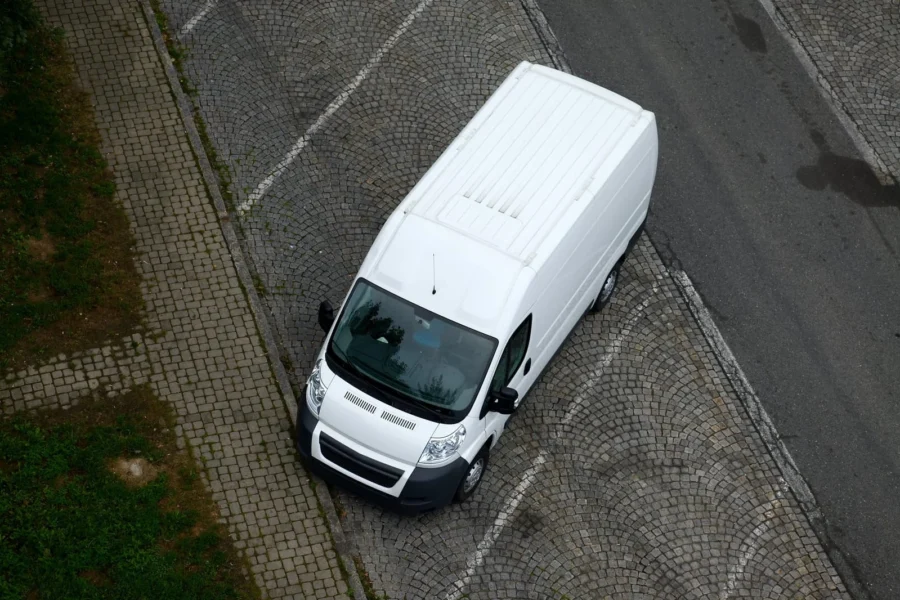
Reversing a hire van is the part of the job that catches out capable drivers, because almost every habit built up over years of driving a car stops working the moment there is no rear window. Anyone arranging van hire in Warrington for a delivery down a narrow lane, a collection from a private driveway or a load-in at a tight commercial yard is going to spend more of the day manoeuvring than driving. Getting that part right is mostly a matter of adjusting technique before setting off rather than learning it under pressure with a wall behind the bumper.
The Rear Window Is the Habit That Has to Go
In a car, reversing is a matter of turning in the seat and looking through the back window, with the mirrors serving as a supporting check. In a panel van or a box van there is no rear window at all, and the interior mirror shows nothing but the bulkhead. Everything behind the vehicle arrives through the door mirrors, and if the mirrors are wrong then the driver is genuinely blind rather than merely restricted.
This is why the mirror setup at collection matters more than it does with a car. Both mirrors need adjusting from the driving position, with the seat already set where it will stay, so that a sliver of the van’s own bodywork sits at the inner edge of each mirror and the rest of the glass shows the road. That strip of bodywork is the reference point that makes distance judgeable. Without it, a driver has no way of knowing how far out the rear corner is.
Length Changes the Line, Not Just the Space Needed
A longer wheelbase does not simply need a bigger gap. It changes the geometry of every turn, because the rear wheels track a tighter line than the front ones and the back of the vehicle swings wider than expected on the way out. An extra long wheelbase van demands a noticeably wider approach into a driveway than a shorter vehicle, and the difference is felt most on a right-angle turn into a gateway.
Body style adds a second variable. A Luton low loader van carries a box that overhangs the cab, so the front upper corner sweeps through an arc the driver cannot see while concentrating on the mirrors. A flatbed dropside van behaves differently again, with an open bed that makes the rear extremities easier to judge but sides that can catch a gatepost if the turn is cut fine.
Get Out and Look
The single most useful habit is the least fashionable one. Before reversing into any space that has not been used before, stop, get out and walk the ground. It takes twenty seconds and it establishes three things no mirror will show. Whether there is a kerb, bollard or drain cover in the path of the rear wheels. Whether anything overhangs at roof height. And whether the surface is firm enough at the edges, which matters a great deal on a soft verge after rain.
Where someone else is present, using them properly is worth more than waving vaguely. A second person should stand where the driver can see them in one specific mirror, agreed in advance, and should stop signalling and physically intervene if they lose sight of the driver’s face. A helper who steps behind the vehicle to guide it has made the situation more dangerous, not less.
Village Lanes and Cheshire Driveways
The residential geography south of Warrington throws up manoeuvring problems that a straight run down a dual carriageway never will. Deliveries towards Stretton van hire addresses, and the lanes running out past Hatton van hire destinations, involve narrow carriageways with soft verges, blind bends and few passing places. Older properties around Appleton van hire and Lymm van hire often have gateposts set for a horse and cart rather than a long wheelbase van.
The practical approach in these places is to identify the turning point before committing to the lane. Reversing a long vehicle two hundred yards back down a single track road with a queue building behind is a situation worth a great deal of effort to avoid. A minute spent studying satellite imagery of the destination before setting off usually reveals where a van can turn.
Loaded Vans Behave Differently
A van that manoeuvred easily on the way out handles differently once it is full. The steering weights up, the vehicle sits lower on its suspension, and stopping distances lengthen noticeably at the low speeds used when reversing. More importantly, a heavily laden van will not pull away smoothly on a slope in the same way, and a driver who has reversed into a sloping yard may find getting out considerably harder than getting in.
Weight distribution matters here too. A load pushed to the very back of the body lightens the front axle and makes the steering feel vague at exactly the moment precision is needed. Loading heavy items forward, over or just behind the front axle line, keeps the vehicle predictable.
Take the Walk-Around Seriously at Collection
The vehicle check before leaving the depot is the moment to set the mirrors, find the reversing aids and understand the dimensions of the specific van being taken. It is also the moment to ask about anything unfamiliar on the vehicle. The depot is in the centre of Warrington at Cockhedge Shopping Centre on Tilley Street, with easy access and secure on-site parking, and the yard itself gives a reasonable feel for how a vehicle behaves at low speed before it meets a public road.
Drivers who are new to a larger van sometimes benefit from booking for slightly longer than the job strictly needs, so the day does not run to a schedule that encourages rushed manoeuvres. Anyone hiring regularly for this kind of work should look at the van hire special offers before booking, as the terms available may affect how the hire is best arranged.
For advice on which vehicle in the fleet suits a particular access problem, describe the destination rather than guessing at a size. Call 01925 396 222 with the width of the entrance and the space available to turn, or send the details through the online enquiry form. The depot is open Monday to Saturday from 8am to 4pm, and matching the vehicle to the access at the booking stage prevents the most common cause of damage on a hire van.


